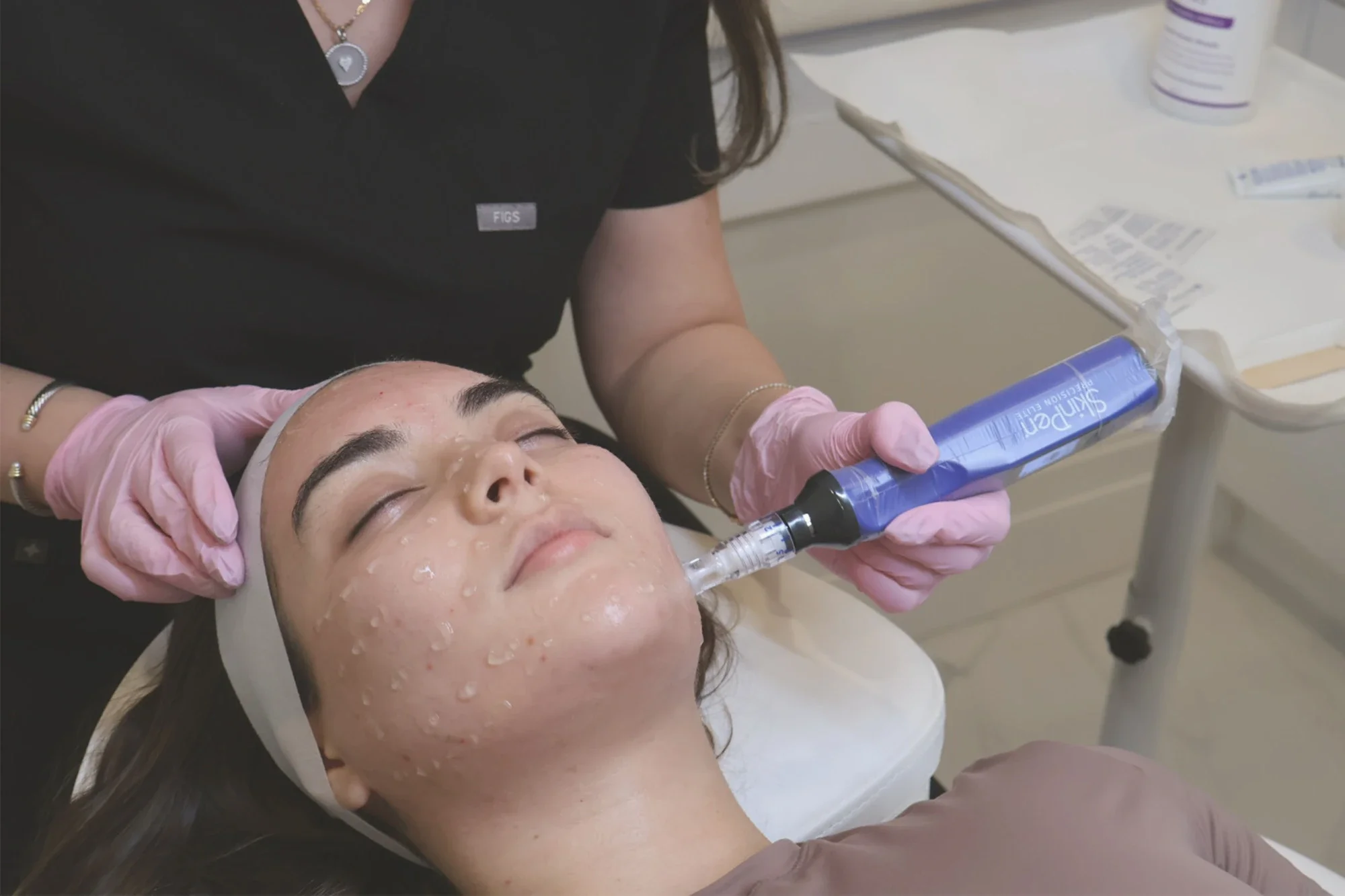
Microneedling is one of the most studied in-office skin treatments for acne scars, fine lines, and uneven texture. It works with your skin's own repair process instead of masking a concern, which is why results build gradually over a series of sessions.
If you have been seeing it on social media and wondering whether it is worth it, this guide covers how microneedling works, what clinical studies actually show, and who tends to get the best results.
What is microneedling?
Microneedling, also called collagen induction therapy, uses a pen-shaped device with very fine, sterile needles to create thousands of tiny, controlled channels in the skin. The American Society for Dermatologic Surgery (ASDS) describes it as a minimally invasive, roughly 30-minute office procedure done with a numbing cream. You can see how we perform it on our microneedling treatment page.
Those micro-channels are too small to leave marks, but they are enough to signal your skin to start repairing itself.
How it works: your skin's natural repair cycle
Micro-injury. The needles create controlled micro-channels at a set depth.
Healing signal. Your skin responds by releasing growth factors and starting its wound-healing process.
New collagen and elastin. Over the following weeks, the skin builds new collagen and elastin, the proteins that keep skin firm and smooth.
Remodeling. Over several months, that new support gradually softens scars, fine lines, and rough texture.
Because the surface of the skin stays largely intact, recovery is usually much shorter than with more aggressive resurfacing treatments.
What can microneedling help with?
Microneedling is most often used for these concerns:
Acne scars. This is where microneedling shines. By rebuilding collagen beneath rolling and boxcar-type scars, it gradually lifts and softens them so skin looks smoother and more even.
Fine lines and wrinkles. New collagen and elastin help skin look firmer, softening early lines around the eyes, mouth, and forehead.
Rough or dull texture. If your skin feels bumpy or looks tired, microneedling helps refine the surface for a smoother, healthier-looking glow.
Enlarged pores. As the skin around them firms up, pores can look smaller and your complexion more refined.
Uneven tone and dark spots. As part of a personalized plan, microneedling can help improve the look of hyperpigmentation and blotchy tone.
Stretch marks and other scars. It is also used on stretch marks and some surgical or injury scars, helping them blend in with the surrounding skin over time.
ASDS lists acne scars, other scars, stretch marks, enlarged pores, and overall texture among its common uses. The U.S. Food and Drug Administration (FDA) has cleared professional microneedling devices for facial acne scars, wrinkles on the face and neck, and abdominal surgical scars.
What does the research say?
The strongest evidence for microneedling is in acne scars, with solid support for texture and early signs of aging. Here is what published studies show.
Acne scars. A 2022 meta-analysis of 12 randomized controlled trials (414 participants) in Aesthetic Plastic Surgery found microneedling improved acne scars more than the comparison treatments, with less post-inflammatory hyperpigmentation (dark marks after treatment).
Combination treatments. Pairing microneedling with other therapies can boost results. A 2022 meta-analysis in Frontiers in Medicine found microneedling with platelet-rich plasma (PRP) worked better for acne scars than microneedling alone. A 2025 review of nine studies found microneedling combined with a chemical peel outperformed either treatment alone.
Collagen and aging skin. In a 2015 study in the International Journal of Dermatology, skin biopsies taken after six sessions showed significant increases in several types of collagen and in elastin precursors. The authors also noted that maintenance sessions are usually needed to keep the improvement.
Safety. A systematic review of 85 studies covering about 2,800 patients, published in Dermatologic Surgery, found most side effects were temporary, such as redness, swelling, and mild flaking. Most allergic reactions were linked to products applied during treatment, not to the needling itself.
What the research doesn't say yet. Many anti-aging studies are small, and many test microneedling combined with other products. Results vary by person, which is why a consultation and a realistic plan matter more than any single study.
Microneedling with PRP at Astoria Esthetics
Astoria Esthetics also offers microneedling with PRP (platelet-rich plasma). A small amount of your own blood is drawn and spun to concentrate the platelets, which carry natural growth factors. The PRP is then applied during microneedling so it can reach the fresh micro-channels.
As noted above, research suggests the pairing can improve acne scars more than microneedling alone. Ask about PRP at your consultation, or learn more on our microneedling page.
Who is microneedling good for?
Microneedling works for both women and men, across a wide range of ages and skin tones. The FDA has cleared professional microneedling devices for women and men aged 22 and older.
Women. Many women choose microneedling for fine lines, acne scars, enlarged pores, or skin that looks dull. It is a popular option for anyone who wants gradual, natural-looking change without much downtime.
Men. Men often come in for acne scars, deeper texture, and enlarged pores. Microneedling suits men who want visible skin improvement with a short recovery and no long-term skincare overhaul. Your provider will plan around facial hair and shaving.
All skin tones. Microneedling does not rely on heat or light at the skin's surface, so it is often a good choice for medium and deeper skin tones. ASDS notes it can be performed on patients of any skin color, and a 2016 review in the Journal of the American Academy of Dermatology found it a promising option for darker skin types, while calling for larger studies. Darker skin can still develop temporary dark marks, so careful technique, skin prep, and daily sunscreen matter.
You may need to wait or choose another treatment if you:
Have active acne breakouts, a cold sore, or a skin infection in the treatment area
Are pregnant or breastfeeding
Tend to form keloid scars
Have eczema, psoriasis, or rosacea flaring in the area
Take blood thinners or have a bleeding disorder
Have a condition or take medication that affects healing or your immune system
Your provider will review your health history at your consultation before recommending treatment.
What to expect from your treatment
Curious how a session feels, how long recovery takes, or how to care for your skin afterward? We walk through every step, from prep to aftercare, on our microneedling page.
Is microneedling safe?
When performed by a trained professional with a sterile, single-use needle cartridge, microneedling has a strong safety record. The most common side effects are temporary: redness, swelling, tightness, mild bruising, and flaking that usually fade within days.
Less common risks include temporary dark marks (more likely in deeper skin tones or without sun protection), infection, and reactions to products applied during treatment.
Why professional treatment matters. The FDA recommends having microneedling done by a provider with specific training, notes that no medical microneedling device is cleared for over-the-counter sale, and advises asking how devices are cleaned between patients. At-home rollers use shorter, blunter needles and cannot safely reach the depth needed for scars or wrinkles.
Microneedling at Astoria Esthetics
At Astoria Esthetics, every microneedling plan starts with a consultation. We look at your skin, talk through your goals, and recommend a number of sessions that fits your concern, whether that is acne scars, fine lines, or texture.
We can also tell you honestly if another treatment, such as a facial, would suit you better right now.
Ready to see if microneedling is right for you?
Book your complimentary consultation, and we'll look at your skin, talk through your goals, and build a plan that fits you.
Have questions about pain, downtime, or how many sessions you need? Our microneedling page answers the most common ones.